


Page 771 - General Catalogue
P. 771
INTRODUCTION

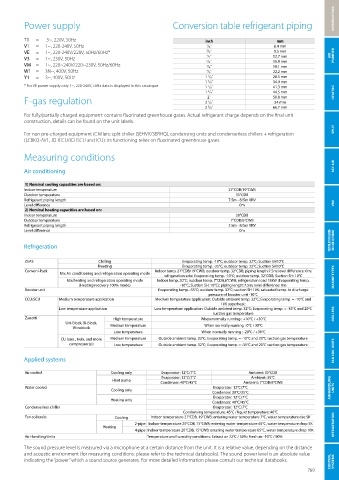
          Power supply                                        Conversion table refrigerant piping


          T1   =    3~, 220V, 50Hz                                       inch                     mm
          V1   =   1~, 220-240V, 50Hz                                     1 /4˝                  6.4 mm
          VE   =   1~, 220-240V/220V, 50Hz/60Hz*                          3 /8˝                  9.5 mm
          V3   =   1~, 230V, 50Hz                                         1 5 /2˝                12.7 mm             AIR   PURIFIER
                                                                          /8˝
                                                                                                 15.9 mm
          VM   =   1~, 220~240V/220~230V, 50Hz/60Hz                       3 /4˝                  19.1 mm
          W1   =   3N~, 400V, 50Hz                                        7 /8˝                  22.2 mm
          Y1   =   3~, 400V, 50Hz                                        1  /8˝                  28.5 mm
                                                                          1
                                                                         1  /8˝                  34.9 mm
                                                                          3
          * For VE power supply only 1~, 220-240V, 50Hz data is displayed in this catalogue.  1  /8˝  41.3 mm
                                                                          5
                                                                          3
                                                                         1  /4˝                  44.5 mm              HEATING
                                                                          2˝
          F-gas regulation                                               2  /8˝                  50.8 mm
                                                                                                 54 mm
                                                                          1
                                                                          5
                                                                         2  /8˝                  66.7 mm
          For fully/partially charged equipment: contains fluorinated greenhouse gases. Actual refrigerant charge depends on the final unit
          construction, details can be found on the unit labels.
                                                                                                                      SPLIT
          For non pre-charged equipment (Chillers: split chiller (SEHVX/SERHQ), condensing units and condenserless chillers + refrigeration
          (LCBKQ-AV1, JEHCCU/JEHSCU and ICU): its functioning relies on fluorinated greenhouse gases.
          Measuring conditions
                                                                                                                      SKY AIR
          Air conditioning
          1) Nominal cooling capacities are based on:
          Indoor temperature                                                     27°CDB/19°CWB
          Outdoor temperature                                                       35°CDB
          Refrigerant piping length                                              7.5m - 8/5m VRV
          Level difference                                                           0m                               VRV
          2) Nominal heating capacities are based on:
          Indoor temperature                                                        20°CDB
          Outdoor temperature                                                     7°CDB/6°CWB
          Refrigerant piping length                                              7.5m - 8/5m VRV
          Level difference                                                           0m
                                                                                                                     VENTILATION & BID-  DLE AIR CURTAINS
          Refrigeration


          ZEAS                      Chilling                     Evaporating temp. -10°C; outdoor temp. 32°C; Suction SH10°C
                                   Freezing                      Evaporating temp. -35°C; outdoor temp. 32°C; Suction SH10°C
          Conveni-Pack                                 Indoor temp. 27°CDB/19°CWB; outdoor temp. 32°CDB; piping length:7.5m; level difference: 0m;
                      Mix Air conditioning and refrigeration operating mode
                                                           refrigeration side: Evaporating temp. -10°C; outdoor temp. 32°CDB; Suction SH: 10°C  MARINE TYPES
                        Mix heating and refrigeration operating mode    Indoor temp. 20°C; outdoor temp. 7°CDB,6°CWB; refrigeration load 18kW (Evaporating temp.
                             (Heating recovery 100% mode)       -10°C; Suction SH: 10°C); piping length:7.5m; level difference: 0m
          Booster unit                                   Evaporating temp. -35°C; outdoor temp. 32°C; suction SH 10K; saturated temp. to discharge
                                                                          pressure of booster unit -10°C
          CCU/SCU     Medium temperature application    Medium temperature application: Outside ambient temp. 32°C; Evaporating temp. = -10°C and
                                                                               10K superheat;
                      Low temperature application      Low temperature application: Outside ambient temp. 32°C; Evaporating temp. = -35°C and 20°C
                                                                            suction gas temperature                   CHILLERS
          Zanotti                        High temperature               When normally running : +10°C / +30°C
                        Uni-Block, Bi-Block,   Medium temperature         When normally running : 0°C / 30°C
                           Wineblock
                                         Low temperature                 When normally running : -20°C / +30°C
                      CU (one , twin, and more   Medium temperature  Outside ambient temp. 32°C; Evaporating temp. = -10°C and 20°C suction gas temperature
                         compressor(s))  Low temperature  Outside ambient temp. 32°C; Evaporating temp. = -35°C and 20°C suction gas temperature

          Applied systems                                                                                             FAN COIL UNITS

          Air cooled                    Cooling only      Evaporator: 12°C/7°C          Ambient: 35°CDB
                                                          Evaporator: 12°C/7°C           Ambient: 35°C
                                        Heat pump
                                                         Condenser: 40°C/45°C          Ambient: 7°CDB/6°CWB
          Water cooled                                                      Evaporator: 12°C/7°C                     AIR HANDLING   UNITS
                                        Cooling only
                                                                            Condenser: 30°C/35°C
                                                                            Evaporator: 12°C/7°C
                                        Heating only
                                                                            Condenser: 40°C/45°C
          Condenserless chiller                                             Evaporator: 12°C/7°C
                                                                 Condensing temperature: 45°C / liquid temperature: 40°C
          Fan coil units                 Cooling      Indoor temperature 27°CDB, 19°CWB; entering water temperature 7°C, water temperature rise 5K
                                                2-pipe Indoor temperature 20°CDB, 15°CWB; entering water temperature 45°C, water temperature drop 5K
                                     Heating                                                                          REFRIGERATION
                                                4-pipe  Indoor temperature 20°CDB, 15°CWB; entering water temperature 65°C, water temperature drop 10K
          Air Handling Units                         Temperature and humidity conditions: Extract air 22°C / 50%; Fresh air -10°C / 90%
          The sound pressure level is measured via a microphone at a certain distance from the unit. It is a relative value, depending on the distance
          and acoustic environment (for measuring conditions: please refer to the technical databooks). The sound power level is an absolute value
          indicating the “power” which a sound source generates. For more detailed information please consult our technical databooks.  CONTROL   SYSTEMS
                                                                                                             769

